Price and delivery time on request. Personal advice from Grubatec.
Model overview.
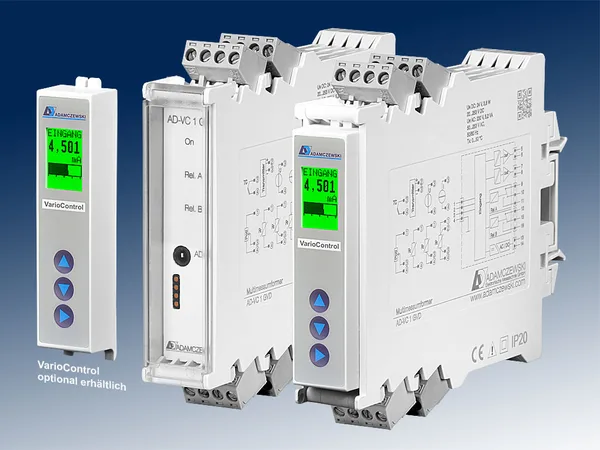
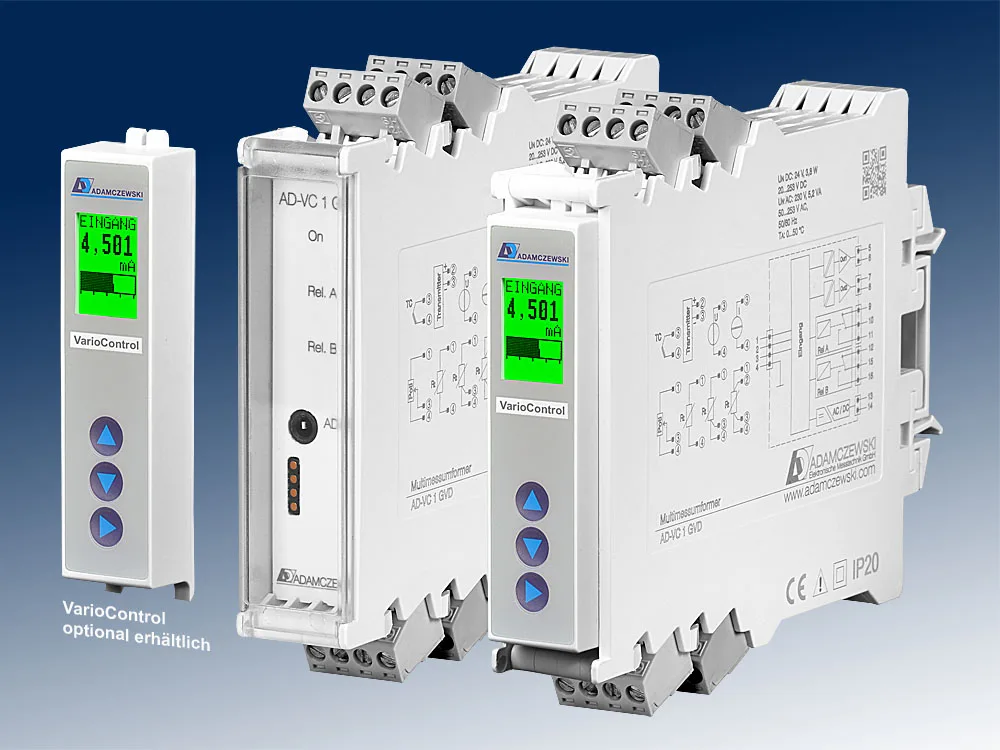
The AD-VC 1 GVD-R0 processes standard analogue signals, temperature signals, resistance signals and potentiometer signals and provides two analogue outputs. Measuring ranges and characteristic curves can be configured using AD-Studio or the optional AD-VarioControl operating module to suit the signal source.
Manufacturer
Adamczewski Elektronische Messtechnik GmbH
Model
AD-VC 1 GVD-R0
Function
Digital multifunction transmitter for standard and temperature signals, with analogue outputs
Input
Standard analogue signal input, transmitter power supply, potentiometer, RTD, PT, NI, thermocouples, mV
Output
Standard analogue signal output
Power supply
Wide-range power supply
Housing type
GVD
Input types
Unipolar standard signal, temperature, transmitter power supply, multifunction input, mV-DC, potentiometer, resistance
Output types
Unipolar standard signal, bipolar standard signal
Supply types
Wide range, DC 20-30V, AC 230V
Interface / protocols
AD-UART
Display / operation
clip-on display
Design
DIN rail, plug-in terminals, screw terminals
Device functions
Simulation, freely configurable, standard signal conversion, galvanic isolation (I/O), 1:1 standard signal isolation, setpoint generation, freely scalable
Further technical data for the device family
These details come from the manufacturer’s shared page for the device family. Where several versions exist, individual values apply only to the variant specified. The data sheet for your particular version is authoritative.
Current input
Measuring range
-24 ... + 24 mA DC
Input resistance
20 Ohm
Basic accuracy
4 µA
Transmitter power supply
No-load supply voltage
24.0 V
Supply voltage at 20mA
18.0 V
Current limitation
~ 25 mA
Voltage input
Measuring ranges
0 ... + 12 V DC
Input resistance
1 MOhm
Basic accuracy
1 mV
Voltage input mV 1)
Measuring ranges
-15 ... +15 mV
-30 ... +30 mV
-60 ... +60 mV
-125 ... +125 mV
-250 ... +250 mV
Input resistance
1 MOhm
Basic accuracy
20 µV
Thermocouples
Note
Cold junction:
Internal
Measurement with a sensor at the internal device terminals
External
Cold-junction temperature selectable via parameter
Note
According to DIN EN 60584:
Measuring range type J
-200 ... +1200 °C
Measuring range type T
-200 ... +400 °C
Measuring range type K
-200 ... +1360 °C
Measuring range type E
-200 ... +1000 °C
Measuring range type N
-200 ... +1300 °C
Basic accuracy
1 K
Note
According to DIN EN 60584:
Measuring range type S
-40 ... +1760 °C
Measuring range type R
-40 ... +1760 °C
Measuring range type B
+400 ... +1800 °C
Basic accuracy
2 K
Note
According to ASTM standard E988:
Measuring range type C
0 ... +2320 °C
Basic accuracy
2 K
Resistance input 1)
Note
Resistance thermometers DIN EN 60751: Pt100, Pt500 and Pt1000 DIN 43760: Ni100, Ni500 and Ni1000
Measuring range Pt
-200 ... +850 °C
Measuring range Ni
-60 ... +230 °C
Minimum measurement span
20 K
Short-circuit detection
< 20 Ohm
Basic accuracy
0.2 K
Note
Linear resistance
Measuring range
0 ... 4000 Ohm
Basic accuracy
0.1 Ohm
Note
Not specified
Connection technology
2-wire, 3-wire or 4-wire
Sensor power supply
100 µA
Max. lead resistance 2)
50 Ohm/conductor
Potentiometer input
Connection technology
3-wire
Permissible total resistance
50 Ohm ... 100 kOhm
Sensor power supply
<=500µA
Cable length
< 30 m, must remain within the building
Current outputs
Maximum output range
-21.5 ... 21.5 mA DC
Maximum load
400 Ohm
Ripple
20 µA p-p
Voltage outputs
Maximum output range
-10.5 ... 10.5 V DC
Minimum load
10 kOhm
Ripple
10 mV p-p
Relay outputs A...D
Contacts R2 / R4
2 changeover contacts / 4 changeover contacts
Max. AC switching capacity
250 V AC, 2 A AC, 50Hz
Max. DC switching capacity
40 V DC, 2 A DC
Note
Switching cycles
Mechanical
107
AC: 230V / 2A, cos(phi)=1
6 * 105
AC: 230V / 2A, cos(phi)=0.4
2 * 105
DC: 24V / 1A
2 * 105
Transfer characteristics
Linearity error
< 0.2 % of the measuring range
Temperature influence
+/- 120 ppm/K of the measuring range
Rise time
500 ms (0...90 %, 100...10 %)
Rise time (temperature input)
< 1s (0...90 %, 100...10 %)
Power supply
AC voltage range
50 ... 253 V AC, 50/60 Hz
DC voltage range
20 ... 253 V DC
Rated AC/DC voltage
230 V AC / 24 V DC
AC/DC power consumption
5.4 VA / 3.4 W
AC/DC power consumption with operating module
5.6 VA / 3.8 W
Housing GVD
Dimensions (w×h×d)
23x110x134 mm
With operating module (w×h×d)
23x110x138 mm
IP rating
IP 20
Connection technology
Removable screw terminals
Terminal conductor cross-section
2.5 mm² stranded wire / 4 mm² solid wire
Terminal tightening torque
0.5 Nm
Weight
~ 150 g
Construction
35 mm DIN rail
Housing GVF
Dimensions (w×h×d)
33x110x134 mm
With operating module (w×h×d)
33x110x138 mm
IP rating
IP 20
Connection technology
Removable screw terminals
Terminal conductor cross-section
2.5 mm² stranded wire / 4 mm² solid wire
Terminal tightening torque
0.5 Nm
Weight
~ 200 g
Construction
35 mm DIN rail
Ambient conditions
Permissible ambient temperature
-10 ... 70 °C
Storage and transport
-20 ... 70 °C (avoid condensation)
EMC
Product family standard 3)
EN 61326-1
Emissions
EN 55011, CISPR11 class B, group 1
Electrical safety
IP rating
2 (EN 60529)
Product family standard
EN 61010-1
Overvoltage category
II
Altitude
Max. 2000 m
Pollution degree
2
Galvanic isolation, working voltages 4)
Input / output
300 V DC or AC RMS EN 61010-1: table 6/7 5) 6)
Input / power supply
300 V DC or AC RMS EN 61010-1: table 4 5)
Output / power supply
300 V DC or AC RMS EN 61010-1: table 4 5)
Galvanic isolation, test voltages
Input / output
2.5 kV, 50 Hz / 1 min.EN 61010-1: table 6/7 5) 6)
Input / power supply
4 kV, 50 Hz / 1 min.EN 61010-1: table 5 5)
Output / power supply
4 kV, 50 Hz / 1 min.EN 61010-1: table 5 5)
Note
1) Use a screened cable for the connection.
Note
2) With a 2-wire connection, lead resistance introduces an offset into the measurement.
Note
3) Minor signal deviations may occur during interference.
Note
4) Maximum voltage continuously applied across the insulation.
Note
5) Double or reinforced insulation.
Note
6) Maximum continuous input-side common-mode voltage relative to earth potential: 50 V AC RMS or 120 V DC
Other versions.
Models in the same device family. Differences may include inputs and outputs, power supply or housing type.

 New
 New