

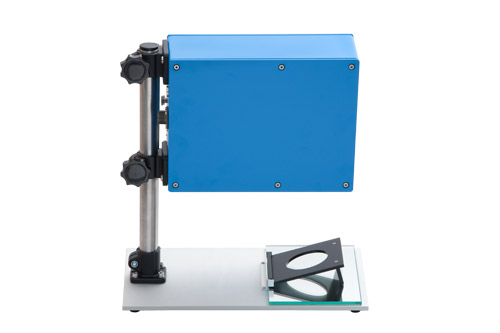

Our reflectance photometers are particularly suitable for checking solids such as wood, minerals or grains. The product to be measured is illuminated with light of a suitable wavelength. The light reflected by the measured material is spectrally evaluated by the photometer.

The reflectance photometers from GRUBATEC AG are used in various industrial fields for quality control. Typical applications are, for example, the moisture measurement of sand, grain, wood, polymers, etc., the concentration measurement of certain minerals in crude salt, the thickness measurement of coatings, foils and films as well as the determination of the whiteness of sugar.
The raw data of the measurement are transmitted to an evaluation device where they are converted into the desired values, such as moisture, concentration or thickness. Our photometers work without affecting the measured material and the measurement result is available in fractions of a second, in the case of individual measurements after just a few seconds.
Numerous optional add-on components are available for your specific applications, such as temperature sensors, dust protection, EX design, mechanical traverses, fiber optics and much more.
| Type | Reflection photometer | Type2 | PVB moisture meter |
| Name | RMK 10/24 | Name | RMK-9T |
| suitable for: | Solids | suitable for: | PVB film |
| Light source | application specific | Light source | Tungsten lamp |
| Mass | 8-10 kg | Mass | 8 kg |
| Dimensions | 300 x 225 x 125 mm | Dimensions | 330 x 345 x 360 mm |
Application examples Reflection photometer
In reflection photometry, the material to be measured is illuminated. The reflected light is filtered by a special optical system according to optimum wavelengths and then measured. The reflectivity of the material to be measured at certain wavelengths depends on the concentration of certain substances. Therefore, the wavelength filters have an influence on the measuring range and the accuracies achieved and are selected accordingly according to customer requirements.
The following table presents some examples of measurements that we have already been able to realize for our customers.
|
Substance to be measured |
Carrier material |
Measuring range(s) |
| Carnallite | Kieserite | 12 %, 50 % |
| Carnallite | Raw salt | 10 %, 30 %, 50 % |
| Dolomite | Sand | 10% |
| Feldspar | Sand | 3% |
| Fat | Meat | |
| Limestone | Sand | 10% |
| Kieserite | Carnallite | 60% |
| Kieserite | Raw salt | 10 %, 30 %, 85 % |
| Adhesive | Textiles | Thickness |
| Magnesium chloride | Raw salt | 25% |
| Magnesium oxide | Raw salt | |
| Water (humidity) | Acetoacetic acid | 10% |
| Water (humidity) | Acrylic glass | |
| Water (humidity) | Acrylic polymer | 2 %, 10 % |
| Water (humidity) | Acrylonitrile | 60% |
| Water (humidity) | Aluminum | 10% |
| Water (layer thickness) | Aluminum | 10 µm, 30 µm, 10 g/m² |
| Water (humidity) | Aluminum hydroxide | 15 %, 20 % |
| Water (humidity) | Alumina | 1 %, 2 %, 10 %, 50 % |
| Water (humidity) | Ammonium nitrate | 4% |
| Water (humidity) | Ammonium phosphate | |
| Water (humidity) | Ammonium sulfate | 2000 ppm |
| Water (humidity) | Ash | 35 %, 80 % |
| Water | Car paint | |
| Water (humidity) | Cotton | 20 %, 50 % |
| Water (humidity) | Calcium hydroxide | 30% |
| Water (humidity) | Calcium phosphate | 40% |
| Water (humidity) | Casein | 50% |
| Water (humidity) | Cellulose | 12 %, 20 %, 40 %, 70 % |
| Water (humidity) | Cellulose acetate | 30% |
| Water (humidity) | Cellulose nitrate (gun cotton) | 2% |
| Water (humidity) | Fertilizer | 3 %, 10 %, 20 % |
| Water (humidity) | Egg cartons | 5% |
| Water (humidity) | Egg powder | 8% |
| Water (humidity) | Enzymes | 10% |
| Water (humidity) | Earth | 10 %, 30 % |
| Water (layer thickness) | Television tubes | |
| Water (humidity) | Felt | 10% |
| Water (humidity) | Photo film | 5000 ppm, 3%, 5%, 20% |
| Water (humidity) | Gelatine | 12 %, 20 % |
| Water (humidity) | Cereals | 30% |
| Water (humidity) | Plaster | 15 %, 25 %, 30 % |
| Water (humidity) | Glycogen | 10% |
| Water (humidity) | Granules | 2000 ppm, 1%, 7%, 10%, 20%, 30%. |
| Water (humidity) | Rubber | 2000 ppm, 5000 ppm, 1%, 2%, 5%, 20%. |
| Water (humidity) | Wood | 5 %, 10 %, 20 %, 40 %, 55 % |
| Water (humidity) | Wood veneer | 5 %, 10 %, 20 % |
| Water (humidity) | Wood chips | 2 %, 5 %, 10 %, 15 %, 20 %, 30 %, 40 %, 55 % |
| Water (humidity) | Insulation material | 60% |
| Water (humidity) | Coffee powder | 5 %, 10 %, 16 % |
| Water (humidity) | Lime | 70% |
| Water (humidity) | Sand-lime brick | 30 %, 40 % |
| Water (humidity) | Lime slurry | 10 %, 40 %, 50 % |
| Water (humidity) | Kaolin | 20 %, 70 % |
| Water (humidity) | Potato chips | 5 %, 60 % |
| Water (humidity) | Potatoes | 3 %, 50 % |
| Water (humidity) | Potato powder | 5 %, 15 %, 30 %, 40 % |
| Water (humidity) | Ceramic materials | 1 %, 2 %, 5 %, 10 %, 20 % |
| Water (humidity) | Silica | 5% |
| Water (humidity) | Sewage sludge | 50 %, 60 % |
| Water (humidity) | Crispbread | 7% |
| Water (humidity) | Caffeine | 1% |
| Water (humidity) | Coal | 3 %, 10 % |
| Water (humidity) | Coconut | 20% |
| Water (humidity) | Chalk | 1 %, 30 % |
| Water (humidity) | Cresol | |
| Water | Copper | |
| Water (humidity) | Magnetite | 15% |
| Water (humidity) | Corn powder | 12 %, 15 % |
| Water (humidity) | Marble powder | 2 %, 8 % |
| Water (humidity) | Flour | 9 %, 25 % |
| Water (humidity) | Methylcellulose | 15 %, 65 % |
| Water (humidity) | Milk powder | 6 %, 8 %, 10 % |
| Water (humidity) | Garbage | 20 %, 60 % |
| Water (humidity) | Nylon | 5000 ppm, 1%, 2%, 10% |
| Water (humidity) | Paper | 2 %, 5 %, 8 %, 10 %, 20 % |
| Water (humidity) | Cardboard | 5% |
| Water (humidity) | Perborate | |
| Water (humidity) | Polyacrylonitrile | 1% |
| Water (humidity) | Polycarbonate | 5000 ppm |
| Water (humidity) | Polyester | 10% |
| Water (humidity) | Polyethylene | 5000 ppm |
| Water (humidity) | Polystyrene | 2000 ppm |
| Water (humidity) | Polyvinyl chloride (PVC) | 5000 ppm, 1%, 2%, 5%, 10%, 30%. |
| Water (humidity) | Potash | 10% |
| Water (humidity) | Proteins | 15% |
| Water (humidity) | Pyrite | |
| Water (humidity) | Quartz sand | 6% |
| Water (humidity) | Tire fabric | 5% |
| Water (humidity) | Beet pulp | 15 %, 50 %, 60 %, 85 % |
| Water (humidity) | Seeds | 15% |
| Water (humidity) | Sawdust | 2 %, 14 % |
| Water (humidity) | Salt | 500 ppm, 4 %, 10 %, 25 % |
| Water (humidity) | Sand | 5 %, 10 %, 15 %, 30 % |
| Water (humidity) | Slag | 5 %, 20 % |
| Water (humidity) | Chocolate | 5% |
| Water (humidity) | Ballast | 25% |
| Water (humidity) | Heat shrink film | 2% |
| Water (humidity) | Silk | 15% |
| Water (humidity) | Soap | 8 %, 20 %, 30 % |
| Water (humidity) | Rare earths | 20% |
| Water (humidity) | Silver granules | 100 ppm |
| Water (humidity) | Sinter | 20% |
| Water (humidity) | Soda | 20% |
| Water (humidity) | Plywood | 10% |
| Water (humidity) | Explosives | 30% |
| Water (layer thickness) | Steel | Thickness |
| Water (humidity) | Tobacco | 17 %, 20 %, 25 %, 60 % |
| Water (humidity) | Textiles | 5 %, 10 %, 20 %, 30 %, 40 % |
| Water (humidity) | Pet food | 10% |
| Water (humidity) | Titanium dioxide | 2 %, 4 % |
| Water (humidity) | Sound | 7 %, 10 %, 14 %, 20 %, 25 % |
| Water (humidity) | Peat | 20 %, 50 %, 60 %, 70 % |
| Water (layer thickness) | Watch glasses | Thickness |
| Water (humidity) | Vinyl chloride | 1000 ppm, 2000 ppm, 1 % |
| Water (humidity) | Fleece | 20 %, 100 % |
| Water (humidity) | Vulcafor | 2 %, 5 % |
| Water (humidity) | Waffles | 6 %, 10 %, 20 % |
| Water (humidity) | Wall painting | 10% |
| Water (humidity) | Washing powder | 5 %, 10 %, 20 % |
| Water (humidity) | Absorbent cotton | 3% |
| Water (humidity) | Wool | 5 %, 10 % |
| Water (humidity) | Dental fillings | 20% |
| Water (humidity) | Cement | 5 %, 15 %, 30 % |
| Water (humidity) | Lemon peels | 2% |
| Water (humidity) | Sugar | 2 %, 3 % |
| Whiteness | Sugar | |
| Xylene | Aminoanthraquinone | 5000 ppm |
The measuring principle
The illuminated sample reflects light in a very specific way. To the human eye, this appears as the color of the sample. Depending on the application, our measuring instruments can see other wavelengths than the eye. For example, moisture is measured in the near infrared.
The optics of the photometer focus the reflected light onto a suitable photodetector. Its signal is amplified and converted into the measurement result with the aid of the calibration parameters.

If necessary, additional correction functions are taken into account; for example, if the measurement result depends on the product or sensor temperature or other components in the product.
The reflection measuring device operates according to a special alternating light method that is characterized by a particularly high temporal constancy. As a result, many interfering influences have only a negligible effect on the measurement result.
The wavelengths for the measurement are selected from these sections of the electromagnetic spectrum depending on the material:
| Ultraviolet (UV) | 190-400 nm |
| Visible light (VIS) | 400-700 nm |
| Near Infrared (NIR) | 700-2500 nm |
| Infrared (IR) | 2500-4700 nm |
Calibration
For a reliable measurement, the photometer must be calibrated. For this purpose, material samples are measured whose composition is well known - either from the production process or by specific measurement with an independent method. From this, the characteristic curve of the photometer is determined, with which each measured value within the measuring range can be assigned to a value of the physical quantity sought.
Traversing device for measurement on webs, foils and discs
In the production of films and other web-shaped materials such as paper, glass or sheet steel, the measurement of parameters across the width of the material is desired. This requires the movement of the measuring heads across the material. PIER-ELECTRONIC designs and builds measuring traverses for this purpose according to your requirements.
Light guide
Point measurements at close distance (5 mm) are possible with flexible fiber optic attachments. This possibility is used in narrow ratios.