
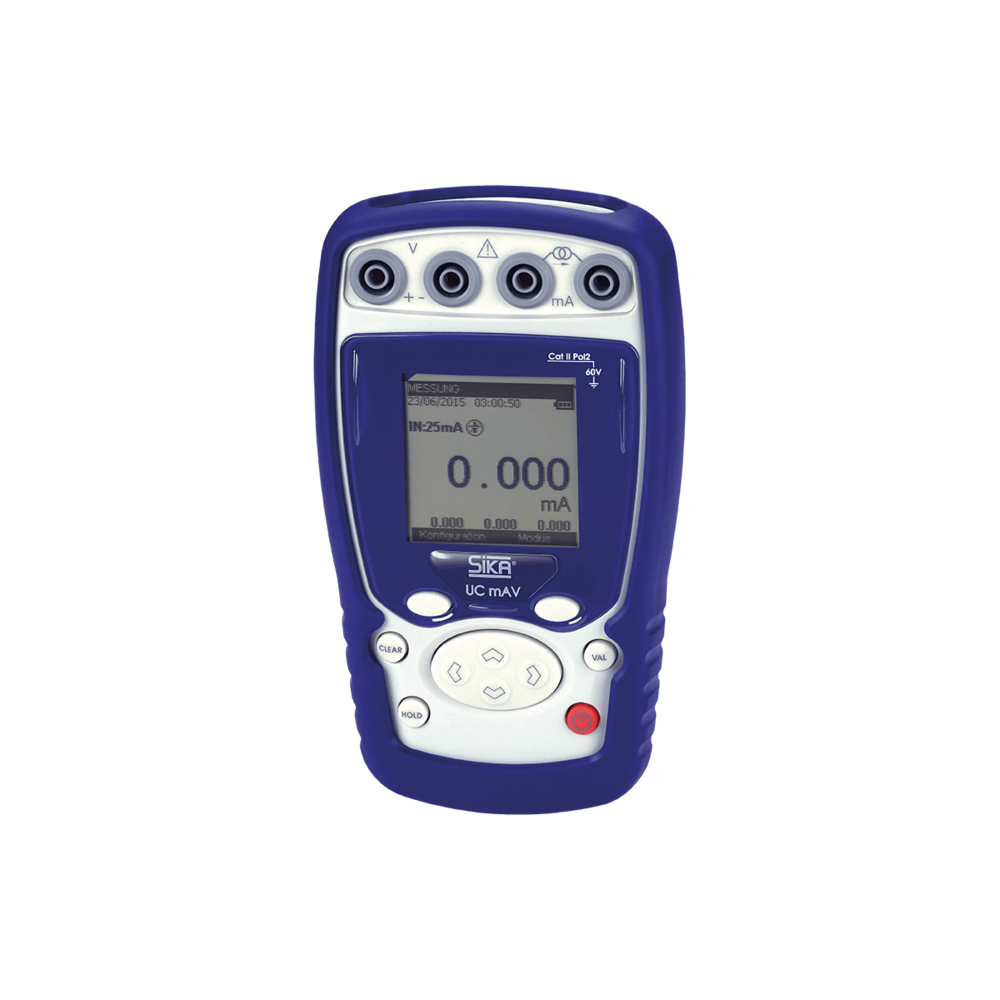
Type UC mAV.2 Monofunction process calibrators for current and voltage signals
Precise simulation and measurement of RTD signals / Easy operation and robust housing / For mobile on-site calibration

SIKA process calibrators were developed to make calibration and maintenance tasks more flexible and easier. With them, different test sequences can be completed in one pass without changing instruments, which saves time. Monofunction process calibrators are particularly useful when only one type of signal is required.
They are mainly used in the following applications:
- Service, maintenance and repair
- Quality assurance
- Testing laboratories and research
- Measurement and control technology
- Process industry
- Energy supply
- Mechanical and apparatus engineering
as well as in many other areas.
The backlit multifunction display clearly shows input and output values as well as all settings made. In addition to the widely used keyboard-guided operation by means of rubber keys, the convenient menu-guided operation via function keys, navigation cross and numeric keypad also enables easy mapping and activation of extensive functions.
If a periodic recall is required, an automatic program run can be created in which signal type, duration and value are defined. Start delay, number of repetitions as well as a continuous, linear ascending or descending course can be specified individually. Signal values that are required again and again can be stored in the simulator in a fixed or flexible manner and can be called up quickly at the push of a button.
The synthesizer function helps to generate a discontinuous course with changing signal values. Here, previously programmed alternating signal heights are output at the simulator's output. In this way, staircases, ramps or synthesizer values can be easily defined and called up one after the other to help fulfill the test task.
In order to achieve exact measuring results, the characteristic measuring properties and deviations of a probe, if they are available in the form of a calibration certificate, should be taken into account during the measurement. By means of offset programming, the simulator input can be shifted linearly and adjusted to the existing measurement curve of the probe. This single-point adjustment is the simplest and best-known way of improving the measurement results. For higher demands on the measurement accuracy, a multi-point adjustment can be used, in which the input is ideally adapted to the real sensor curve by means of four linearization points in order to compensate for linearity errors. Up to five different adjustment sets can be directly stored and easily recalled.
| Generate loop current signal |
| 0 (4)...25 mA |
| Generate voltage signal |
| 0...10(15) V |
Technical data