01
Thermal radiation
Depending on its temperature, the object being measured emits electromagnetic thermal radiation.


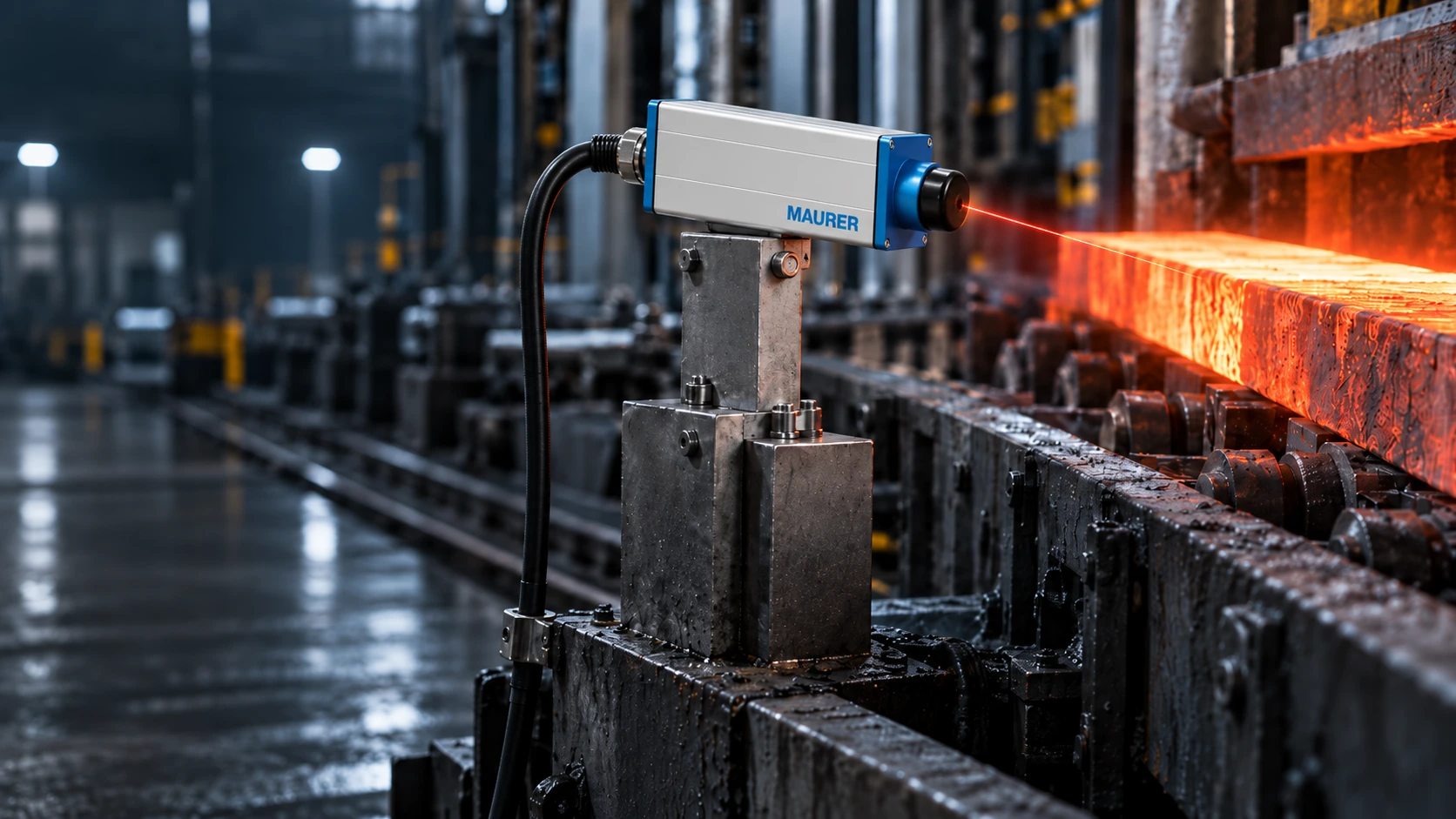
Pyrometers detect the thermal radiation emitted by a target and convert it into a temperature reading. This makes it possible to measure even hot, moving, or hard-to-reach objects quickly and without direct contact.
From thermal radiation to a measurable temperature value.
Depending on its temperature, the object being measured emits electromagnetic thermal radiation.
The optical system collects the radiation within a defined measurement spot and directs it to the detector.
A detector converts the received radiation into an electrical measurement signal.
The electronics process the signal and use it to calculate the corresponding temperature value.
The table lists selected metals, their melting points, and a preliminary guide to suitable pyrometer series.
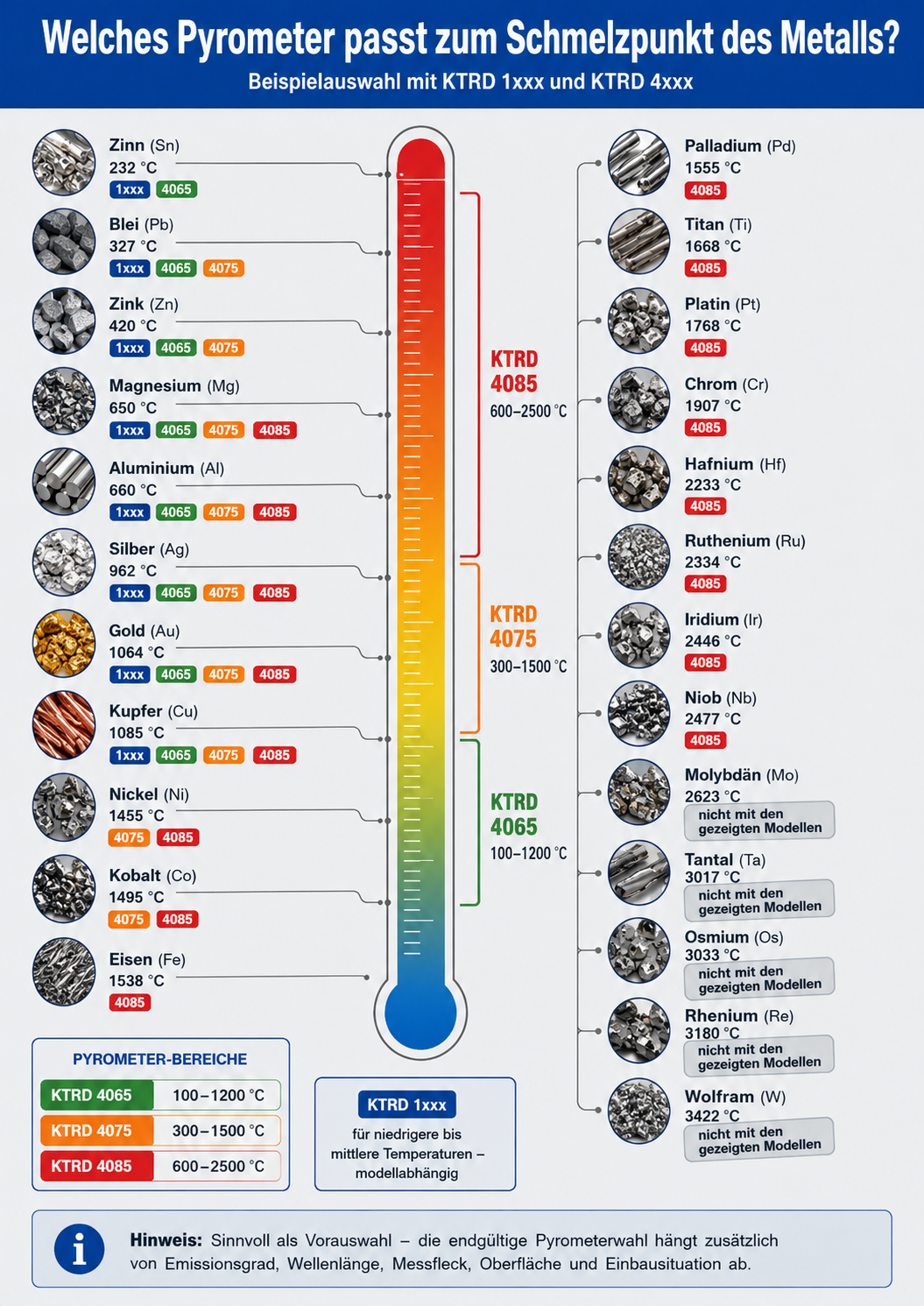
Depending on the material, temperature, surface, measurement distance, and process speed, different device models are used.
Temperature control directly on the workpiece during short, dynamic heating cycles.
Reproducible temperature monitoring during hardening, tempering, and heat treatment.
Noncontact inspection of red-hot workpieces before and during forming.
Measurements on castings, molten metal, ladles, and outgoing molten metal jets.
Temperature monitoring along production and forming lines in operation.
Temperature monitoring at solder joints, welds, and areas subjected to brief heating.
Fast measurement of small or moving workpieces using appropriate optics.
Surface temperature measurement for materials with suitable emissivity characteristics.
Potential measurement solution for glass-ceramics, hot glass products, and furnace processes.
Integration into test benches, test facilities, and customer-specific process solutions.
The temperature range alone is not sufficient. The material, measurement geometry, environmental conditions, and required signal output must all be considered together.
Determine whether the surface is metal, plastic, glass, a coating, or another type of surface.
Define the minimum and maximum temperatures as well as the required process margin.
Take into account the measurement spot, distance, movement, smoke, dust, and the surrounding environment.
Select wavelength, optics, response time, interface, and accessories.
The scale shows the approximate range of key device groups. The actual measurement ranges depend on the model and configuration.
Plastics, nonmetals, and lower surface temperatures.
Typical metalworking processes in the low- to medium-range.
For red-hot workpieces and dynamic production processes.
For very high metal temperatures and demanding processes.
Universal machines, compact machines, two-color technology, high-speed, and fiber-optic solutions are selected to suit the system.
Stationary universal pyrometers with flexible optics and a wide range of technical customization options.
Compact pyrometers for direct installation in machines and confined areas of plants.
Ratio pyrometers for applications involving smoke, dust, soot, or a partially obscured measurement field.
The measuring head and electronics are physically separated to better protect the electronics.
High-speed operations for moving workpieces, short cycles, and dynamic temperature changes.
Extensions for process visualization, data logging, PID control, and the detection of poorly positioned workpieces.
Depending on the environment and surface, a special design or an additional technical inspection may be necessary.
A two-color solution may be more robust in cases of partial attenuation. The specific measurement situation must be evaluated.
Fiber-optic solutions isolate sensitive electronics from hot or hard-to-reach measurement points.
Emissivity, oxidation, coating, surface roughness, and the condition of the material have a decisive influence on the measurement.
For the final selection, wavelength, emissivity, surface, measurement spot, measurement distance, motion, environment, and desired response time must be evaluated together. The product families shown represent a technical preselection and do not constitute final device approval.
Please send us the material, temperature range, measurement distance, measurement spot, surface condition, process speed, and desired interface. We will determine the appropriate series and configuration.