Rapid heating
Induction Heating
Temperature control directly on the workpiece during short, dynamic heating cycles.
- Gears, shafts, and bearing rings
- Tubes, Bolts, and Rods
- Shrinking, Soldering, and Annealing


From induction, hardening, and forging to casting, rolling, plastics, and research: Our pyrometers offer flexibly configurable solutions for fast, precise, and noncontact temperature measurements.
The maps show typical and potential areas of application. Using the filters, you can narrow down the areas of application by process group.
Temperature control directly on the workpiece during short, dynamic heating cycles.
Reproducible temperature monitoring during hardening, tempering, and heat treatment.
Noncontact inspection of red-hot workpieces before and during forming.
Measurements on castings, molten metal, ladles, and outgoing molten metal jets.
Temperature monitoring along production and forming lines in operation.
Temperature monitoring at solder joints, welds, and areas subjected to brief heating.
Fast measurement of small or moving workpieces using appropriate optics.
Surface temperature measurement for materials with suitable emissivity characteristics.
Potential measurement solution for glass-ceramics, hot glass products, and furnace processes.
Integration into test benches, test facilities, and customer-specific process solutions.
It's not just the temperature that matters. For a reliable measurement, several technical factors must align.
Determine whether the surface is metal, plastic, glass, or coated.
Set the minimum and maximum temperatures as well as the process margin.
Evaluate the measurement spot, distance, motion, smoke, dust, and the surrounding environment.
Select wavelength, optics, response time, interface, and accessories.
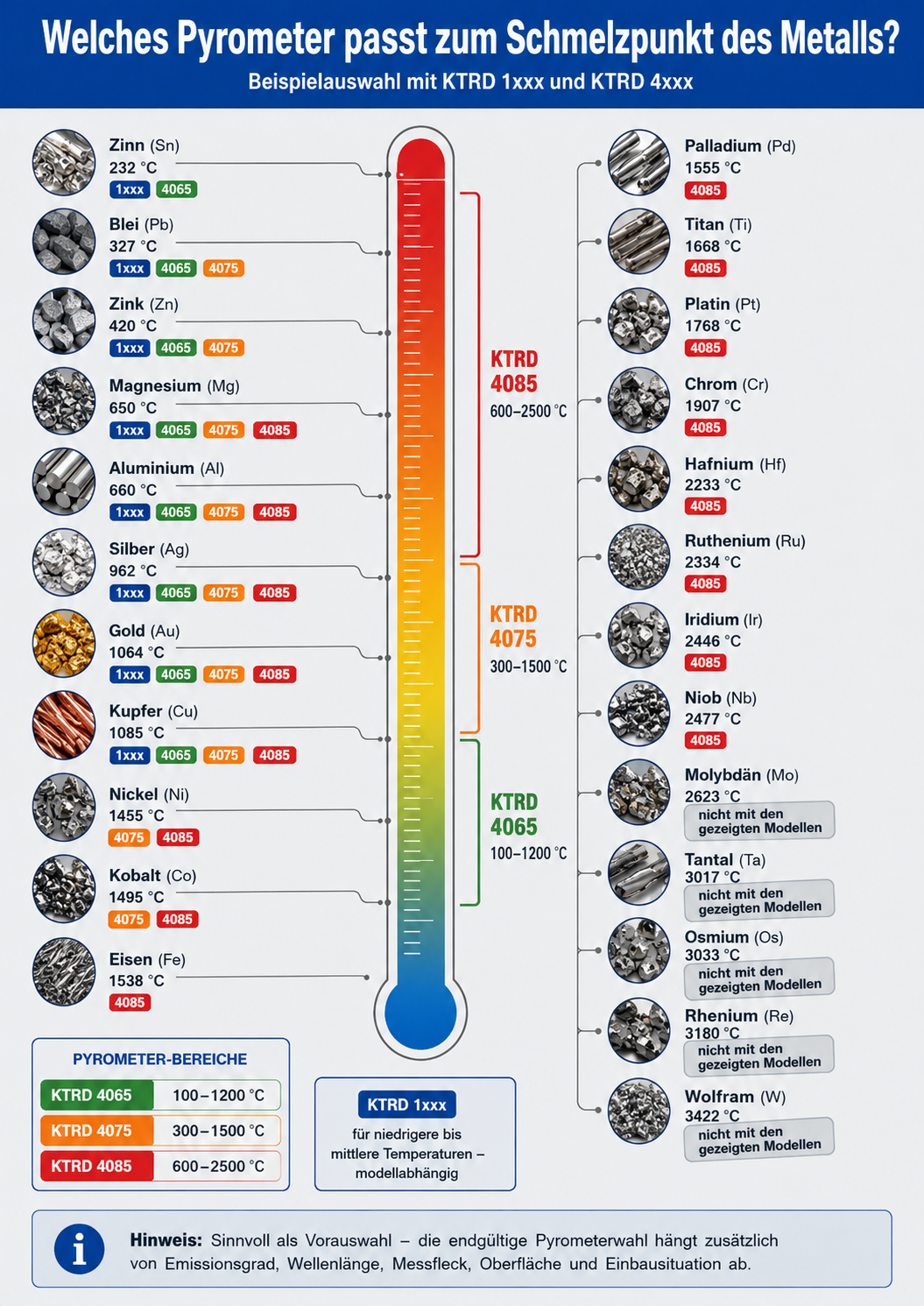
The scale shows the approximate range of the main device groups. The actual measurement ranges depend on the model and configuration.
Plastics, nonmetals, and lower surface temperatures.
Typical metalworking processes in the low- to medium-range.
For red-hot workpieces and dynamic production processes.
For very high metal temperatures and demanding processes.
The product philosophy is straightforward: universal machines, compact machines, two-color technology, high-speed machines, and fiber-optic solutions are combined to suit the specific production line.
Stationary universal pyrometers with flexible optics and a wide range of technical customization options.
Compact pyrometers for direct installation in machines and confined areas of plants.
Ratio pyrometers for applications involving smoke, dust, soot, or a partially obscured measurement field.
The measuring head and electronics are physically separated to better protect the electronics.
High-speed operations for moving workpieces, short cycles, and dynamic temperature changes.
Extensions for process visualization, data logging, PID control, and the detection of poorly positioned workpieces.
These guidance charts show when a specific design or additional technical testing is advisable.
A two-color solution may be more robust in cases of partial attenuation. The specific measurement situation must be evaluated.
Fiber-optic solutions isolate sensitive electronics from hot or hard-to-reach measurement points.
Emissivity, oxidation, coating, surface roughness, and the condition of the material have a decisive influence on the measurement.
For the final selection, wavelength, emissivity, surface, measurement spot, measurement distance, motion, environment, and desired response time must be evaluated together. The product families shown are therefore a professional preselection and do not constitute final device approval.
Please send us the material, temperature range, measurement distance, measurement spot size, surface condition, process speed, and desired interface. We will determine the appropriate series, wavelength, optics, and device configuration.
Check your application now