

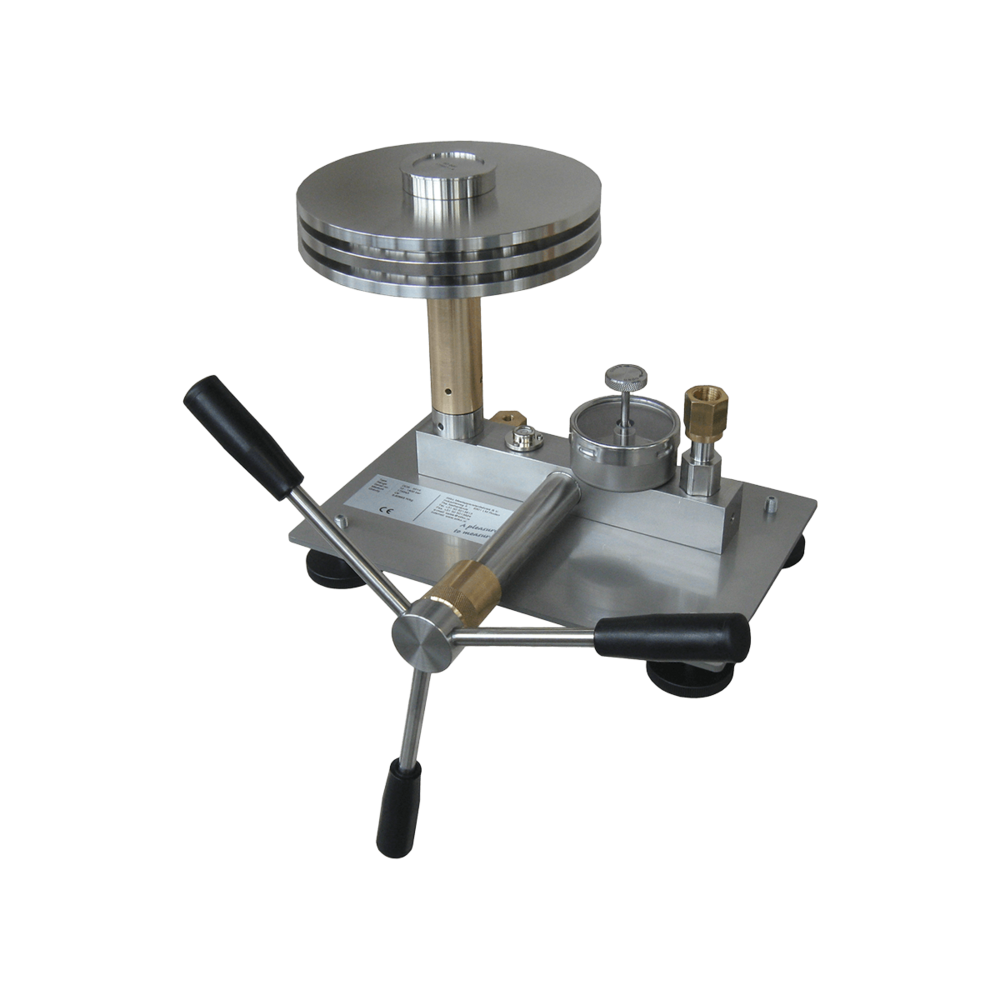
Type ODWT15B Hydraulic Oil Pressure Gauge Pressure Range up to 1400 bar
High-precision pressure standard for calibrations up to 1,400 bar

ODWT15B Hydraulic Oil Pressure Gauge for High-Precision Pressure Calibrations
The SIKA ODWT15B is a hydraulic oil pressure gauge designed for highly precise calibration, testing, and comparative measurements in pressure measurement technology. Depending on the piston and weight set used, it can cover pressure ranges from 0.25 to 1,400 bar.
With an accuracy of 0.015% of the measured value, the ODWT15B is particularly well-suited for applications that require high measurement accuracy, excellent repeatability, and a reference that remains stable over the long term.
Typical applications include calibration laboratories, quality assurance, metrology, service, and industrial test stations.
High-precision mechanical measurement principle
The operating principle of the ODWT15B is based on a precision-machined piston-cylinder system and calibrated weights. The weights exert a defined force on the piston. At the same time, the hydraulically generated pressure acts from below on the effective area of the piston.
When the downward force of gravity and the counterforce generated by the pressure are in equilibrium, the piston floats in its intended measurement position. The pressure generated in this process can be used as a reference value to verify the connected pressure gauge.
Accuracy of 0.015% of the measured value
The ODWT15B achieves an accuracy of 0.015% of the measured value. This makes it suitable for demanding calibrations of pressure gauges and reference instruments.
To ensure the highest accuracy, factors such as the local acceleration due to gravity are taken into account in addition to the calibrated masses and the effective piston area.
Adjustment for the local acceleration due to gravity
Since the pressure generated depends directly on the weight of the masses placed on it, the local acceleration due to gravity plays an important role. The ODWT15B is therefore calibrated to account for the local acceleration due to gravity.
This allows the system to be optimally tailored to its future location.
Wide calibration range up to 1,400 bar
The ODWT15B offers an exceptionally wide operating range thanks to various piston sets. Depending on the model, it can handle very low hydraulic pressures starting at 0.25 bar all the way up to high-pressure applications with a maximum of 1,400 bar.
This allows the pressure gauge to be flexibly adapted to various calibration tasks.
Five different piston sets
Five piston sets are available for different pressure ranges:
- Piston Set 1: up to 70 bar
- Piston Set 2: up to 140 bar
- Piston Set 3: up to 280 bar
- Piston Set 4: up to 700 bar
- Piston Set 5: up to 1,400 bar
By using a different piston-cylinder system, the calibration range can be expanded without necessarily requiring an entirely new load cell system.
Interchangeable pistons for maximum flexibility
A distinctive feature of the ODWT15 series is the ability to use different piston-cylinder assemblies. This allows the same base unit to be configured for different pressure ranges.
Changing the piston-cylinder system, for example, allows for the transition from a lower pressure range to a higher one.
Tungsten carbide piston-cylinder system
The piston-cylinder assembly is made of tungsten carbide. This material is characterized by very high hardness and excellent dimensional stability, making it particularly suitable for high-precision mechanical measurement systems.
The precise manufacturing of the piston-cylinder system contributes significantly to the high measurement accuracy and repeatability of the pressure gauge.
High-quality stainless steel gauge sets
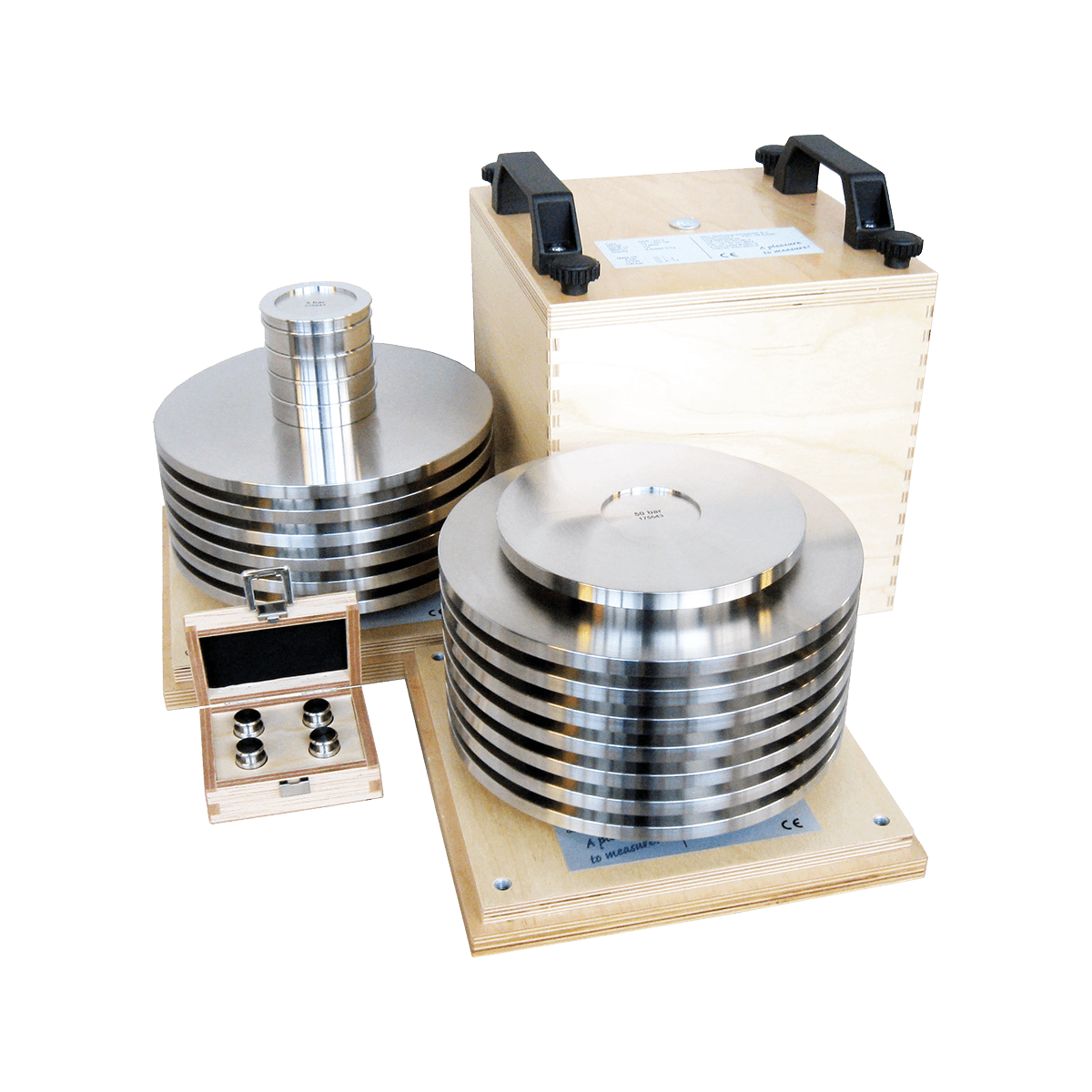
The calibration weights consist of antimagnetic stainless steel discs. The individual weights, together with the corresponding piston system, form the basis for the desired test pressure.
Depending on the selected pressure range, mass sets with a total weight of up to 56 kg can be used.
Hydraulic Pressure Generation Using Oil
The ODWT15B uses Miglyol 812N DWT oil as the pressure medium. Pressure is generated hydraulically by the integrated screw pump.
By slowly operating the screw pump, the system pressure is increased until the piston, with the weight set attached, reaches its defined floating position.
Working Easily with Defined Pressure Levels
The desired test pressure is generated by selecting the appropriate piston system and applying the required weights.
Once equilibrium has been reached, the measured value of the connected test specimen can be compared with the reference pressure of the pressure gauge. Additional weights can then be added or removed to reach further test points.
What devices is the ODWT15B suitable for?
The oil pressure gauge is particularly suitable for calibrating and testing:
- Pressure Gauges
- Digital Pressure Gauges
- Pressure Sensors
- Pressure Transmitters
- Pressure Transducers
- Reference Pressure Gauges
- Test Gauges
- industrial pressure measurement systems
Various pressure connections
The ODWT15B features a G⅜ pressure connection with a left-hand thread. Adapters for G⅛, G¼, G⅜, and G½ female threads are available for various test specimens.
This allows various pressure gauges to be flexibly connected to the pressure gauge.
Stable setup for precise measurement results
For high-precision calibrations, the pressure balance must be placed on a stable, level surface. The built-in spirit level and leveling feet allow the device to be aligned exactly horizontally.
During the measurement, vibrations, strong air currents, and significant temperature fluctuations should be avoided.
Recommended Temperature Range
A stable temperature range of 18 to 22 °C is specified for operation of the ODWT15B. A constant ambient temperature helps ensure the high measurement accuracy of the piston-cylinder system.
Calibration and Long-Term Stability
The ODWT15B is designed for high long-term stability. Nevertheless, the piston-cylinder system and the set of weights should be recalibrated regularly.
SIKA recommends an initial recalibration approximately two years after purchase. Depending on operating conditions and frequency of use, recalibration intervals of approximately two to five years are typical thereafter.
Maintenance of the Hydraulic System
The system should be kept clean, as dirt and foreign objects can lead to increased wear. The Miglyol 812N oil used should be checked and replaced regularly, depending on usage and operating conditions.
SIKA recommends changing the oil about once a year as a best practice.
The Key Benefits of the ODWT15B
- High accuracy of 0.015% of the measured value
- Measurement ranges from 0.25 to 1,400 bar
- Five different piston sets
- Replaceable Piston-Cylinder System
- Adjustment for the local normal acceleration
- Tungsten carbide piston-cylinder system
- Mass sets made of antimagnetic stainless steel
- Hydraulic pressure generation using Miglyol 812N oil
- Integrated screw pump for generating pressure
- Suitable for professional calibration and comparative measurements
- Various connection adapters are available
- High long-term stability
Questions and Answers About the ODWT15B Oil Pressure Gauge
What is an ODWT15B oil pressure gauge?
The ODWT15B is a hydraulic pressure balance designed to generate defined reference pressures with high precision. It is used for calibrating and testing pressure gauges.
What pressure range does the ODWT15B cover?
Depending on the piston and weight set used, pressure ranges from 0.25 to a maximum of 1,400 bar can be covered.
How accurate is the ODWT15B?
The specified accuracy is 0.015% of the measured value.
How does a hydraulic pressure gauge work?
Calibrated weights exert a defined force on a precision piston. The hydraulically generated pressure acts on the effective piston area from below. Once both forces are in equilibrium, a defined reference pressure is achieved.
Why are weights used?
The weights exert a defined force on the piston. Combined with the known effective piston area, this allows the pressure generated to be determined.
Why does the piston have to float during the measurement?
The defined floating position indicates that the force generated by the applied masses and the hydraulic pressure force are in equilibrium.
Why is the piston rotated?
During the measurement, the piston is set in rotation using the mass set. This ensures smooth operation of the piston-cylinder system during the measurement.
What type of printing material is used?
Miglyol 812N DWT oil is used as the pressurized medium.
Can any hydraulic oil be used?
The data sheet and operating instructions specify Miglyol 812N as the intended pressure medium. To ensure reliable and metrologically defined operation, the medium specified by the manufacturer should be used.
What piston sets are available?
Five piston sets are available. These allow for maximum pressure ranges of 70, 140, 280, 700, and 1,400 bar, respectively.
Can the print range be changed later?
Yes. By replacing the piston-cylinder assembly, the ODWT15B can be configured for different pressure ranges.
What material is the piston made of?
The piston-cylinder assembly is made of tungsten carbide.
What material are the weights made of?
The mass sets consist of antimagnetic stainless steel discs.
How heavy can a complete set of weights be?
Depending on the selected measurement range, the total weight of the mass set can be up to 56 kg.
Which devices can be calibrated using the ODWT15B?
Typical test items include pressure gauges, digital pressure gauges, pressure sensors, pressure transmitters, and other suitable pressure measuring devices.
What pressure connections are available?
The main connection is a G⅜ left-hand thread. Adapters for G⅛, G¼, G⅜, and G½ female threads are provided.
Why is it necessary to take local gravitational acceleration into account?
The force acting on the piston depends not only on mass but also on the local acceleration due to gravity. For particularly accurate calibrations, this effect is therefore taken into account.
What is the recommended ambient temperature?
A stable temperature range of 18 to 22 °C is specified for operation.
How often should the ODWT15B be recalibrated?
SIKA recommends a first recalibration approximately two years after purchase. Depending on the environment and usage, subsequent recalibrations are typically performed at intervals of about two to five years.
How often should the oil be changed?
Depending on operating conditions and usage, the owner's manual recommends changing the oil about once a year as a best practice.
Are accessories available?
Yes. Among other things, a second set of pistons, a replacement gasket set, and a small set of gauges are available.
Technical data
Technical data
| Type | ODWT15B |
| Execution | Hydraulic Oil Pressure Gauge |
| Pressure range | 0.25…1,400 bar, depending on the piston and mass set |
| Accuracy | 0.015% of the measured value |
| Print Unit | cash |
| Print medium | DWT Miglyol 812N Oil |
| Temperature range | 18…22 °C |
| Pressure connection | G⅜, far left |
| Adapter | G⅛, G¼, G⅜, and G½ (internal) |
| Dimensions without weights | approx. 340 × 225 × 220 mm |
| Maximum height with weights | approx. 450 mm |
| Base Unit Weight | approx. 12.6 kg without the weight set |
| Mass set | up to 56 kg |
| Piston-Cylinder Assembly | Tungsten carbide |
| Mass sets | Antimagnetic stainless steel washers |
| Parts in contact with liquid | Stainless steel |
| O-rings | NBR |
Piston Sets and Pressure Ranges
| Piston Set | Minimum pressure | Maximum Pressure |
|---|---|---|
| Set 1 | 0.25 bar | 70 bar |
| Set 2 | 0.5 bar | 140 bar |
| Set 3 | 1 bar | 280 bar |
| Set 4 | 5 bar | 700 bar |
| Set 5 | 10 bar | 1,400 bar |